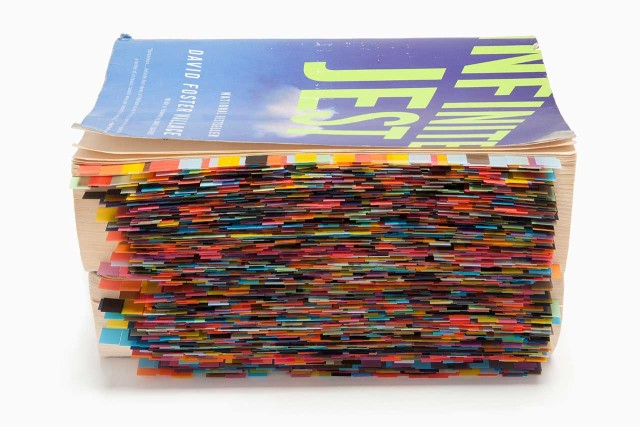
My reaction to the ending seems to be somewhat commonplace. I finished the final pages, endnotes and all, reread the first section again and then immediately googled what the fuck was actually happening. Then I spent an hour abjectly reading theories, realising that I didn’t really have a good idea of the plot. Or, to be honest, any idea of the plot at all. The theories that people have extrapolated from throwaway sentences that seemed to be carefully crafted but I didn’t even register… It made me feel dumb. This didn’t help that DFW himself said that if the ending didn’t come naturally to me then, “the book’s failed you.”
I didn’t see the ending coming. Not by a long shot. But when it was all explained to me in the end, when the plot threads were set out for me in a lovely straight line, it all seemed so obvious. Not far-fetched or beyond the realm of possibility, but as the probable only way that the story itself could be resolved. That’s what bugs me the most. When reading the book I picked up on all the cues; the floating bed, the mold, the affairs, the wraith, the wide-spread inter-connections… but I didn’t put them all together. I couldn’t. It was like being at a pub quiz and having that one question that you flat out didn’t know, that didn’t even register with you as something you would even ever need to know, and it turns out that, when the compere reads out the answers, you did know it, and you can’t believe you didn’t know it, and you’ve lost the quiz now but hey hey you’re with your friends and having a drink and having a good time, right?
And the worst part of this is that I didn’t even see the ending coming, I didn’t even feel an ending. I felt as though there was much more the characters had to offer, and that there was little to no resolution, with the exception of maybe Hal. It wasn’t the unsatisfying feeling of experiencing a story where nothing changes, and that’s kinda the point of the whole thing, as a way of trying to capture what real life is like. Like, the final credits of a film panning over all the characters, doing what they were doing, signalling the end of their narrative as they look off screen to some twangy guitar. It was just that there were people and characters that I thought would have more bearing and impetus on the story. Instead they just didn’t get addressed. The faceless boy, the man with the gun wandering off into the night, the tunnel kids. They all felt like they were set up as a firing squad of chekov’s guns that didn’t go off, and I didn’t see that they were never going to go off, or were even loaded, or even pointing in the same direction. I didn’t know the end of their story, and that made me feel dumb. The book, apparently, failed me.
I suppose that’s my problem, my own ego, that I need to deal with though. For the time being I am trying to focus on what I did take away from it, what I learned from the book. I learned that there is a lot to be said about patience when it comes to writing a scene, a second. DFW took a long time laboring over a thought and an idea, stretching it out over several thin lined pages without ever flogging it. He had a lot of patience and a lot of confidence in what he was trying to express, letting it breathe as he slowly made the point. I admired that.
This is the same with his characters too. He took his time with a lot of them, spreading their lives over the pages he gave them, going into as much detail as he needed. And, as such, he made so many true, breathing people so pitiable and likable and reprehensible at the same time. They had honest relationships with each other, and honest feelings, and he didn’t reserve some of the more poignant insights of the book to his main cast. He treated everyone fairly, giving them their needed due (but, as I sadly feel, no ending). A lot of characters will stay near me, I reckon, for a while yet.
And I took away a sense of hopelessness and despair, but also hilarity and optimism. One of my favourite passages is a simple one, right near the end, almost included just as a throwaway, of a man dressing as a hobo, trying to get someone to touch him. For me that passage was heartbreaking in its story, and seemed to encompass the feeling of the novel. Everything is shit, but everything is also pretty good. That’s maybe what I’ve taken from it.
I think, in the end, Infinite Jest is a book I would recommend to people, but then maybe not talk about it. On the off-chance that someone I know reads it, and then talks to me about it, I’ll be too tempted to pass theories off as my own. I would tell them about the ending, and who was responsible, and how it all fits together, and I would make this person feel dumb because they didn’t suss them out themselves, and I don’t really want to do that. I want them to enjoy the words and the journey, like I did, but I don’t want to make them feel dumb.
 Preemptive Retaliation
Leave a comment